
Read some of the most frequently asked questions about the Canadian Grapevine Certification Network and grapevine certification. Our list of FAQs might just have the answer you're looking for!
Where can I buy CGCN vines?
Vines are available for order at our participating nurseries. Please visit the Certification tab of our website for either Verified or Certified vine availability. We recommend placing vine orders 12-18 months in advance.
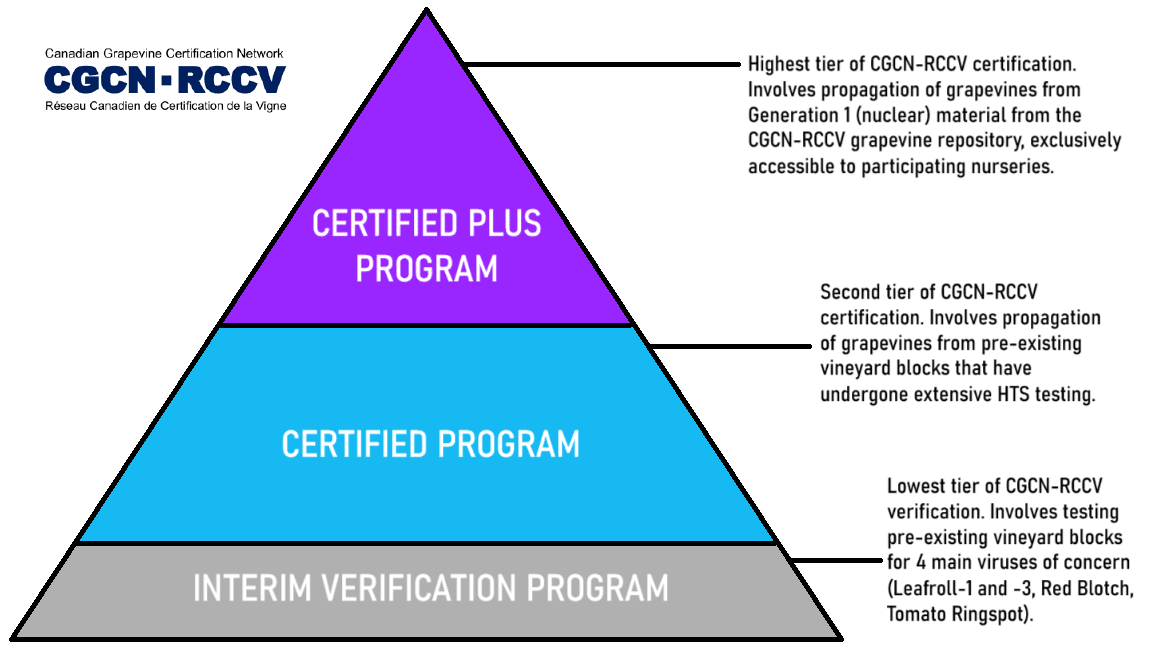
Please note the program differences in the graphic below:
What are grapevine viruses?
Grapevines can get viruses just like people can get sick with the flu or chickenpox. The difference is that people can take medicine to get better, but grapevine viruses are incurable, meaning that the only way to remove the virus from the vineyard is to remove the infected vine(s) and replant with clean material. The effects of viruses on grapes and vines can present in delayed maturity, reduced sugars (aka. Brix), lower cold tolerance, reduced yield and/or shorter vineyard lifespan. The effects of viruses on wine may include light colour, reduced alcohol, increased acidity, and less body & aftertaste. Each of these effects have been shown to result in significant economic losses to grape growers (Bowen et al., 2020).
For a comprehensive explanation of CGCN’s economically important viruses of concern, please visit our “Common Grapevine Viruses” page.
Source: Bowen, P., Bogdanoff, C., Poojari, S., Usher, K., Lowery, T., Úrbez-Torres, J.R. (2020). Effects of grapevine red blotch disease on cabernet franc vine physiology, bud hardiness, and fruit and wine quality. American Journal of Enology and Viticulture, [online] 71(4), 308-318. http://dx.doi.org/10.5344/ajev.2020.20011.
What does the term “virus-free” grapevines really mean?
The term “virus-free” is not an accurate description of clean grapevine material. A more accurate way to describe this grapevine material is “certified clean” or sourced from “virus tested” mother blocks. We want to avoid using the word “free” because the clean material is not tested against ALL viruses to exist, but rather only tested against the viruses that the specific certification program has deemed economically important.
For example, according to CGCN’s Certification programs (“Certified Plus” and “Certified”), material is tested against at least 25 viruses and other pathogens of concern (details in Appendix 5 of each program), but this isn’t consistent across all grapevine certification systems. The viruses that a certification system is testing against will vary based on the viruses and other pathogens that are deemed economically harmful in that region. This is why it’s so important to ask your nursery what viruses they are testing for!
Is it common for grapevine certification programs to certify against Crown Gall?
No. However, within CGCN’s “Certified Plus” program, grapevines produced and propagated according to the conditions as described within this set of protocols regarding Allorhyzobium vitis (Crown Gall) may distinguish their material as sourced from Crown Gall tested plants. Regardless, no certification against Crown Gall is provided on the final product.
How do I protect my clean vines after they are planted? What is the importance of the concept of starting clean, and staying clean?
“Starting Clean” means purchasing CGCN vines from a participating nursery, or if purchasing internationally, vines that are produced according to a CGCN recognized certification system. Although domestic Canadian sources of clean grapevine material are always encouraged and promoted over international sources, CGCN understands that current demand exceeds the capacity of domestic sources.
“Staying Clean” means implementing precautionary processes at the vineyard level. After planting clean grapevines, it is important to do everything within your control to keep the vines from getting infected with viruses and/or other pathogens by managing populations of insects capable of spreading certain viruses and other pathogens (such as mealybugs, soft-scale insects and treehoppers). There are a few precautionary processes you can implement at the vineyard level such as field inspections, equipment cleaning, and vector control and applying insecticides as needed. CGCN recommends the following:
- Field inspections: Monitor the clean plantings for symptoms of viruses and other diseases, especially during the growing season.
- Equipment cleaning: Ensure you are thoroughly cleaning your equipment by removing soil from machines with water and sanitizing handheld items if working in a non-certified block and moving to a “certified clean” block. Alternatively, consider working on clean blocks first and non-certified blocks last.
- Vector control: Regular treatment schedules, or other pest management strategies, must comply with provincial recommendations and treatments must be applied to control potential virus vectors. Follow integrated pest management practices for your province: British Columbia, Ontario (1. sprays, 2. information resources), Quebec (1. sprays, 2. information resources), Nova Scotia.
If vines are showing common signs of infection, regardless of if the block is “certified clean” or not, TEST THEM and consider removing the positives. The earlier the infection is detected, the better your chances of reducing the spread of virus. And when replanting the areas of removed vines, ALWAYS PLANT “CERTIFED CLEAN” GRAPEVINES. There is no cure once vines are infected. The only way to remove infection is to destroy the vines to manage further spread.
Where can I find your webinar recordings?
CGCN regularly hosts timely themed webinars influenced by questions and concerns coming from the industry. You can find a variety of webinars on our website under CGCN Webinars or on our YouTube channel (@CGCN_RCCV).
What if I want a specific scion or rootstock variety to be made available under the clean plant program?
Every year we take suggestions for varieties that the industry would like to see put into CGCN’s Generation 1 (G1) clean plant repository. Once a variety is submitted to the program, it typically takes 2-3 years before an order for cuttings can be placed by one of our participant nurseries. Please contact us if you would like to make a suggestion!
Where can I learn more about CGCN’s research Cluster?
Research is key to ensuring that Canada has a strong, sustainable, thriving grape and wine industry. CGCN currently administers the second iteration of the national AgriScience Grape & Wine Research Cluster (or commonly referred to just as the “Cluster”), under Agriculture and Agri-Food Canada’s Sustainable Canadian Agricultural Partnership (SCAP) framework running from 2023-2028. To keep up to date on active or past projects and results under the Cluster, visit the “Research” tab at the top of our website or dropdown menu, and visit Cluster Updates & Events.
CGCN also administered the first iteration of the Research Cluster under the Canadian Agricultural Partnership (CAP) program from 2018-2023. For final project summaries, please visit Past Research - CAP Cluster 2018-2023.
How can I stay informed of CGCN’s activities?
There are a few ways you can stay in the loop of everything CGCN!
1. Subscribe to our e-newsletter by scrolling to the bottom of this webpage and input your name and email. We release updates every other month.
2. Follow our social media accounts:
Where is CGCN located?
Our office is located at 1634 South Service Road, St. Catharines, Ontario. However, we have Board members in each of our member grape-growing provinces. Meet our Board of Directors here.
Who can I contact if I have any more questions?
Feel free to send us a message or call (905) 688-0990 | Ext. 222

Don't see the answer to your question here?
Learn more about the CGCN, review our research efforts, or contact us for more information.